My approach is based on working with the fascia of the face — often overlooked tissues that play a key role in how wrinkles develop. By identifying areas of tension — particularly between the eyebrows, where frown lines tend to form — it becomes possible to release facial tightness and soften lines in a more lasting way. Myofascial work allows us to act deeper on the structures of the face, targeting the areas where tension gradually builds up and eventually shapes your expressions.
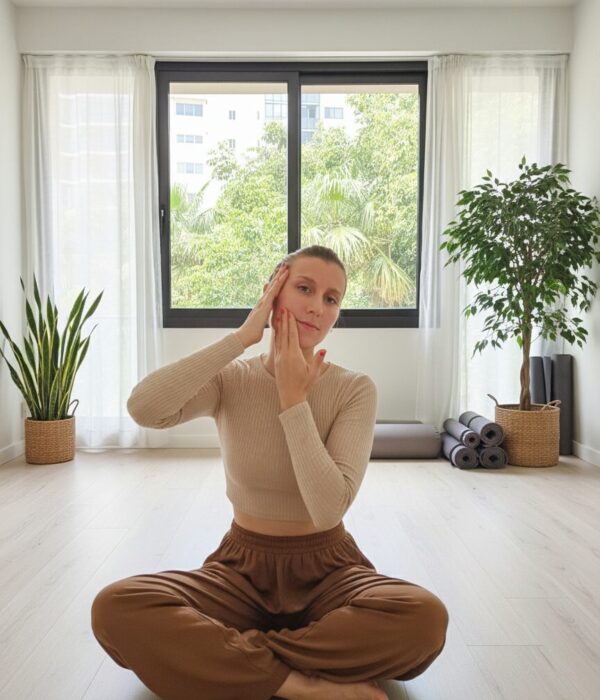
Today, information about face yoga is everywhere. The challenge is no longer a lack of knowledge, but rather an overload: too many exercises, too many methods, too many standardized videos.
As a result, it becomes difficult to know what to do, how to practice properly, and above all whether what you are doing is truly adapted to your face.
However, wrinkles cannot all be approached in the same way. Each face is unique, each skin reacts differently, and every person has their own aging pattern.
Some areas need to be stimulated, others need to be relaxed, and some simply need to be maintained.
This is especially true for frown lines, which are often linked to deep muscular tension between the eyebrows.
The first step is therefore to observe the face: understand its tension patterns, its muscular habits, and how certain wrinkles have developed over time.
Before starting any practice, it is essential to know where to act and why. Once these areas are identified, it becomes possible to build a realistic and personalized routine.
It is not about working the entire face every day, but rather focusing on specific areas — especially those involved in frown lines — and defining a frequency that respects the natural balance of the face.
Instead of repeating generic exercise routines, I guide you in building a practice tailored to your face, one that respects its balance and targets precisely the areas that need attention.
That is why I favor a simple approach: doing less, but doing it more effectively.
Before supporting other women, I personally explored many different techniques.
Not all of them were effective. Some approaches were too gentle to have an impact on my frown lines, which were already well established. Others, poorly explained or not suited to my face, actually increased certain tensions.
By observing my skin, my muscles, and how they evolved over time, I gradually understood what truly worked. By refining my techniques and working more deeply on certain areas — particularly the fascia — my face began to relax and my frown lines visibly softened.
Today, I see these same results in the people I support.
My role is simply to guide you in identifying what is right for your face and to teach you the right techniques.

This diagnosis is a first session to observe your face and understand your needs, with a specific focus on frown lines.
During this online appointment, we review:
your skin and current routine,
areas of tension between the eyebrows,
the evolution of your frown lines.
The goal is to identify priority areas and better understand what contributes to the formation of these lines.
This session is also an opportunity to answer your questions and help you understand where frown lines come from and which areas to work on first.
A structured program over several weeks designed to reduce frown lines and achieve visible and lasting results.
This program is based on progressive work that you can do at home, with step-by-step guidance.
Each stage is adapted to your face to target precisely the area between the eyebrows.
I support you in building your routine, performing it correctly and staying consistent over time.
The program includes:
an initial session to analyze your face, build your routine and guide you in its implementation,
two follow-ups at the beginning (around day 5 and day 10) to adjust your movements and start effectively,
a follow-up session at 4–6 weeks to refine your routine and observe the first results,
a final session to review your progress and make final adjustments,
ongoing support via WhatsApp between sessions.
Everything is done online so you can stay autonomous while being guided.
A session during which I work directly on your face to release deep tension, especially in the area between the eyebrows.
Using precise techniques, I work on muscles and fascia to improve their mobility and progressively soften frown lines.
This session also helps you better understand what creates tension in this area and how it contributes to the formation of frown lines.
Please note
For lasting results, a 5-session approach is recommended.

A progressive 5-session approach to release tension between the eyebrows and reduce frown lines over time.
Unlike a single session, this format allows structured work over time, which is essential to achieve visible and lasting results.
During the first session, we define together the priority areas to work on.
Each session then follows a targeted progression to stimulate the same areas multiple times and create real change.
Between sessions, I guide you with simple techniques to practice at home to reinforce the work done.
This consistency — both during sessions and at home — is key to achieving deep and lasting results.
Please note
The discovery session is included if you choose to continue.
You will also receive a personalized routine adapted to your face to practice between sessions.
Whether your frown lines are recent or more established, this approach is designed to guide you step by step, with precise techniques tailored to your face.
This approach is designed to guide you step by step, with precise and tailored techniques — whether your frown lines are recent or more established.
My approach is based on observing the face and identifying the areas of tension that contribute to the formation of certain wrinkles. By working at the level of the fascia, it becomes possible to release these tensions and approach facial care in a more precise and adapted way. Depending on your needs, we can start with a diagnostic to analyze your face and your frown lines, or move directly to a personalized session.
How can you reduce frown lines naturally?
To soften frown lines naturally, it’s essential to release the tension that maintains the contraction between the eyebrows. Myofascial work helps act on the fascia and facial tissues to restore mobility in the area. As tension gradually decreases, frown lines can appear less pronounced.
Why do frown lines appear?
Frown lines mainly develop due to repeated muscle contractions between the eyebrows, especially when frowning. Over time, the skin loses elasticity and these movements can mark the tissues. Tension in other areas, such as the forehead or scalp, can also contribute to maintaining this contraction.
Can frown lines be removed without injections?
It is difficult to completely erase frown lines naturally, especially when they are already well established. However, it is possible to soften them by working on muscular and fascial tension. This approach improves the appearance of lines without freezing facial expressions.
Why isn’t massaging the frown line always enough?
Massaging only the area between the eyebrows can bring temporary relief, but it is not always sufficient. If the fascia remain restricted or if tension comes from other areas of the face, the contraction quickly returns. This is why a more global approach is often needed.
How long does it take to see results on frown lines?
Results vary depending on each face and the intensity of tension. Some people feel a release quite quickly, but visible improvement usually requires several weeks of consistent practice.
Is face taping useful for frown lines?
Face taping can be a helpful complement, especially to limit involuntary contractions, particularly at night. It does not replace tension-release work, but it can help prevent the area from staying contracted for long periods.
Can certain exercises make frown lines worse?
Yes, poorly performed or overly repeated exercises can reinforce contraction instead of releasing it. That’s why it’s important to understand the source of tension and focus on targeted work rather than repeating movements without precision.
Why are frown lines sometimes more visible in the morning?
Frown lines can appear more pronounced in the morning because some people unconsciously contract the muscles between the eyebrows during the night. This area may remain tense for several hours, temporarily accentuating the appearance of the line upon waking.
Should you work on frown lines every day?
It is not always necessary to work on this area daily. Working too frequently or too intensely can sometimes maintain tension. In my approach, the goal is to alternate areas and focus on precise techniques, allowing tissues time to release.
Why do frown lines come back despite massage?
Frown lines can return even after massage if the work remains superficial. While the muscle may relax temporarily, if the fascia — the tissues that surround and connect the muscles — remain stiff or lack mobility, they keep the area under tension. The muscle then tends to return to its initial position, and the contraction comes back.
In many cases, tension does not come only from the area between the eyebrows. Tension located in the forehead, scalp, or other areas of the face can maintain this contraction. That’s why a more global approach, including fascia and surrounding areas, is often necessary for lasting results.
Dans de nombreux cas, la tension ne vient pas uniquement de la zone entre les sourcils. Des tensions situées dans le front, le cuir chevelu ou d’autres zones du visage peuvent entretenir cette contraction. C’est pour cette raison qu’un travail plus global, incluant les fascias et les zones périphériques, est souvent nécessaire pour obtenir des résultats durables.
Want to take a closer look at your face and your lines?
I support you in building a routine tailored to your skin, your needs, and your goals.
Be the first to receive the dates of upcoming online face yoga workshops, along with all the details to register.
Limited spots — small groups for high-quality guidance.

